
IITB Trust Lab x CyberArk AI & Cybersecurity Leadership Forum
CyberArk, in partnership with IITB Trust Lab, recently hosted an exclusive, invitation-only AI & Cybersecurity Leadership Forum. This closed-door roundtable brought together industry and academic experts to dissect the evolution of cybersecurity in the age of AI.
The intersection of AI and cybersecurity has shifted from a future concept to a present-day reality reshaping enterprise risk. The recent global disruptions caused by CrowdStrike highlighted that even our most trusted security partners are part of a complex ecosystem that requires rigorous oversight and fail-safe architectural planning.
The Evolution of Defense: Beyond the Traditional Firewall
The modern Security Operations Center (SOC) is currently buckling under the weight of its own telemetry, a crisis defined by tools and data overload. This deluge of information frequently results in a high volume of false positives, which triggers a culture of alert fatigue where critical signals are often buried in the noise. To address these challenges, an Autonomous SOC is ideal, since it leverages AI to close these gaps through a continuous feedback loop.
The discussion opened with a critical look at how some foundational security measures are being reimagined through the lens of Artificial Intelligence.
- From Static to Behavioral Defense: While the traditional Firewall remains a staple, the focus has shifted toward Anomaly Detection. By leveraging AI to establish baselines of “normal” user and machine behavior, organizations can now identify subtle deviations that signal a breach long before a signature is detected.
- The War on Deception: As phishing grows more sophisticated, Fake Webpage Detection has become a primary battleground. AI models are now being trained to analyze visual elements, URL structures, and metadata in real-time to intercept credential harvesting sites before they can claim a victim.
- Fraud Detection in the Age of AI: AI in fraud detection is no longer optional. The speed at which synthetic identities are created requires a reciprocal speed in analysis—one that only automated, self-learning systems can provide.
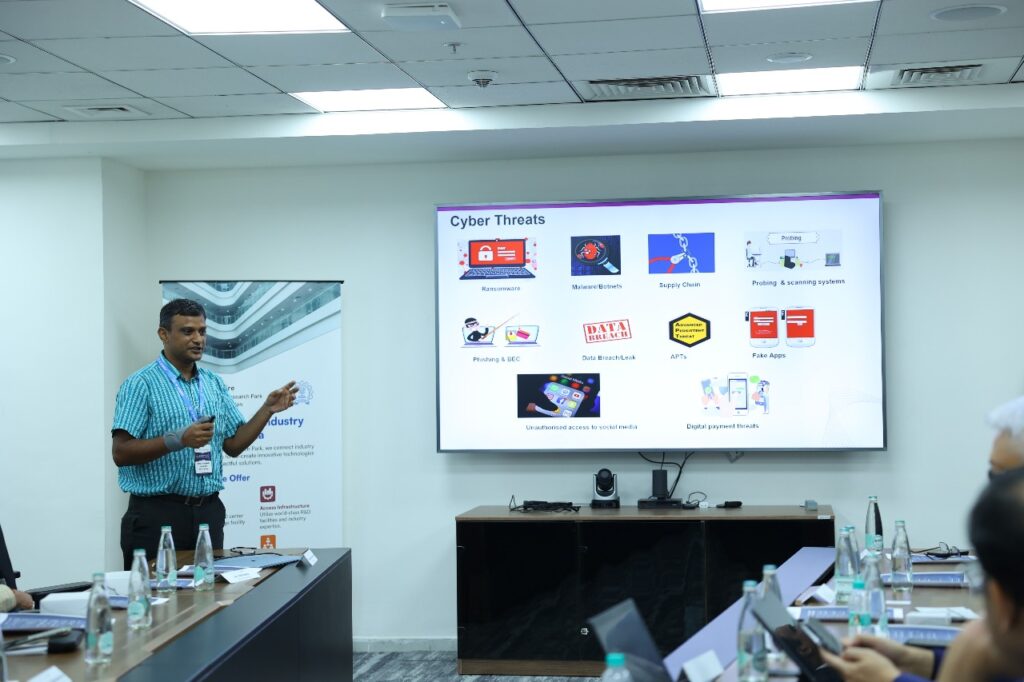
Industry-Specific Perspectives
The panel discussion illuminated how AI is simultaneously creating complex risks and providing the very tools needed to solve them, particularly within high-stakes industries.
A primary concern raised by members from industry involved the internal use of Agentic AI by employees. While these agents can significantly boost productivity, they can become a major security liability depending on their specific tasks and the data they access. AI can mitigate this risk through automated governance, where specialized monitoring agents oversee other AI agents to ensure they do not exceed their authorized scope or inadvertently leak corporate secrets during task execution.
In the pharmaceutical industry, the protection of vast treasures of Intellectual Property (IP) is a constant struggle against sophisticated industrial espionage. AI offers a proactive defense here by utilizing advanced pattern recognition to monitor data access and movement at a granular level. By establishing a behavioral baseline for how researchers interact with proprietary formulas, AI can detect and block high-speed data exfiltration attempts—often initiated by malware or compromised accounts—long before a human analyst could intervene.
The defense industry faces a unique “supply chain of trust” problem, as they must frequently share confidential blueprints with external vendors. The challenge lies in securing data that has left the primary perimeter. AI-driven solutions such as automated data labeling and dynamic access control can help solve this by embedding security directly into the shared files. These systems can use AI to verify the security posture of a vendor’s environment in real-time before granting access, ensuring that blueprints remain protected even when being used by third-party partners.
Towards a Better Security Posture
The forum concluded with the thought that strategic leadership in cybersecurity now requires a good understanding of AI Agents and their role in the future of work. As we move toward an era of autonomous security operations, the “human element” must pivot from manual monitoring to strategic governance.
Rather than replacing human intelligence, this model utilizes AI for the rapid triage and automated remediation of evolving threats at a speed humans cannot match. By shifting the focus from manual monitoring to high-level strategic response, organizations can achieve a more resilient and AI-ready security posture.
